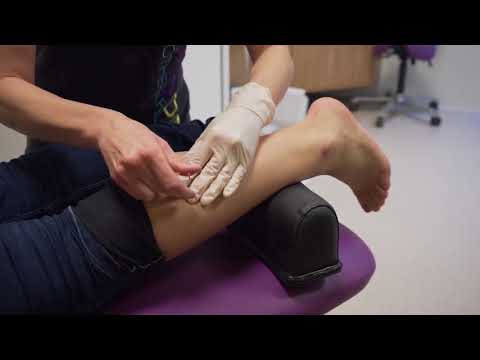
Dry needling
Dry needling is a treatment method in which muscle knots are needled using a special technique involving a small needle. The needling causes the muscle fibres to relax quickly and for a prolonged period.
What is dry needling and how does it work?
Dry needling is a treatment method that involves inserting a needle into muscle knots (trigger points). This is done using a specialised technique involving a small needle. The insertion of the needle causes the muscle fibres to relax quickly and for a prolonged period.
The podiatrist uses dry needling, particularly in the lower limbs, to support the overall treatment plan. Dry needling can be used, amongst other things, to treat conditions such as heel pain, Achilles tendon problems and forefoot problems. When dry needling is used as a treatment, in addition to needling the affected muscles, the patient is also given exercises, advice or other treatment interventions. In this way, the limitations that have arisen can be alleviated as effectively as possible, in order to maintain the long-term benefits of the treatment.
How many dry needling sessions are needed?
The dry needling treatment is spread over five sessions. These sessions are scheduled periodically in consultation with the podiatrist. Clustering the dry needling sessions ensures the best possible treatment outcome. The frequency with which the dry needling sessions are scheduled varies depending on the severity of your condition or your progress towards recovery.
What is a trigger point?
A trigger point is a tense spot in a muscle that, in addition to localised tenderness, often causes referred pain. Dry needling treatment aims to ‘deactivate’ these trigger points. By inserting the needle precisely into the muscle, these trigger points are located and deactivated. The muscles then relax.
Trigger points can manifest as:
- Pain and stiffness localised within the muscle, but often accompanied by referred pain;
- Restricted movement in the associated joints;
- Reduced strength in the affected muscle(s);
- Pain-avoidance behaviour: you start moving ‘differently’ to avoid the pain, as it could lead to other symptoms.
How do trigger points develop?
- Acute: caused by a sudden awkward movement, a strain or a bruise;
- Due to a prolonged poor (working) posture;
- Muscle spasms associated with chronic pain;
- Being unable to move for a long time, for example because of a plaster cast;
- Psychological factors such as stress and depression.
What do you feel during the treatment?
You will feel little or no sensation when the needles are inserted. When the correct trigger point is targeted, the muscle may contract briefly; this feels like a slight jolt. This happens so quickly that it may startle you for a moment. Sometimes it can feel a little painful. After the twinges, the muscle usually relaxes straight away. You may feel a bit warmer, start to sweat, or feel a bit unwell or tired during the treatment. There’s no need to worry about this; it will pass quickly.
What happens after the treatment?
You may experience some nagging residual pain for the first two days. This is simply the treatment continuing to work. You may also feel some tightness or stiffness in the treated muscle. In addition, a bruise may appear temporarily. This will disappear on its own.
Dry needling cannot be used in the following cases:
- Pregnancy
- Pacemaker
- Anticoagulant medication
- Bleeding problems
- Local infections
Reimbursement and referral
Dry needling is covered by most supplementary health insurance policies; this does not count towards your excess. You do not need a referral from your GP or doctor to receive dry needling treatment. We advise you to check with your health insurer in advance of treatment regarding any possible allowances.